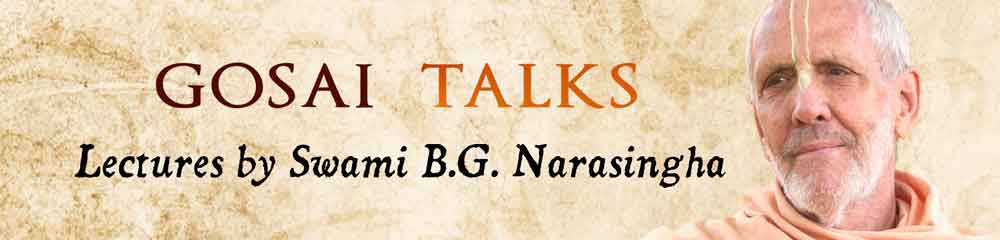
Śāstra: This category covers quotes and excerpts by Swami B.G. Narasingha Maharaja that focus on the study of scripture and its practical application in devotional life. These are quotes and excerpts that have been extracted from articles, lectures and letters by Swami B.G. Narasingha.
FULFILMENT ALONE IS NOT FAVOURABLE!
T
he Bhāgavatam is meant to increase our hankering and our eagerness. It satisfies and it fulfills, but first one must develop a hankering. Within this hankering comes the feeling of fulfilment also. Just fulfilment, as it stands alone, is not in our favour. It will not bring us and keep us in touch with the devotees in this life. It will not enable us to substantially remain in touch with our guru after he departs from this world.
THE SAFE ROAD TO SUCCESS
People in general thinks that because a work is a book of poetry like Gītā-Govinda, then it is ok to read, quote and use. This seems akin to the man who used two śālāgrāma-śilās to crack nuts. To present this book to the general public is vandalism, a violent act against our sampradayā!
I heard that Śrīla Bhaktisiddhānta Sarasvatī Prabhupāda read both Caitanya-caritāmṛta and Caitanya-bhāgavata 108 times and told others to do likewise. The idea is to immerse oneself in the pastimes of Lord Gaurāṅga. There are so many pastimes, especially in the Caitanya-bhāgavata, that one’s desire to hear the Lord’s pastimes will be totally satisfied. This is the safer road to success…
DISBELIEF IS AN ALL-DEVOURING BEAST!
G uru, sādhu and śāstra – sādhu is also there. Not just guru. Now devotees say, “Oh, I have my guru!” But you didn’t have your guru before! Devotees brought you to your guru, devotees explained so many things to you. But why so many devotees feel like that? Because their faith is lost! They see that others cheat, do this, that, this happens, that happens…then they become very, very distrustful. They don’t believe in anybody. They don’t believe in anything. Ultimately they don’t even believe in themselves either. This disbelief is an all-devouring beast! It consumes our own self-confidence also – then we don’t want to even make one step ahead. Guru, sādhu and śāstra – these three things are sung about in Vaiṣṇava poetry, and its what the Śrīmad Bhāgavatam is all about. These things are there to help us in the world, and we must keep our high respect and regard for them.
DON”T JUST QUOTE THE ŚLOKA – PRACTICE IT!
T here was once a young brahmacārī I used to travel with. One day I was trying to remember a śloka and I said, “What is that śloka?”
He said, “Yes, yes! I know that!” And he just came out with the Sanskrit.
So I said, “Well I know you know the Sanskrit, but do you know the meaning? Do you know what the śloka is all about? Can you practice the śloka? It’s one thing to say the śloka – it’s another thing to put it into practice!